
Brotherhood Of G.O.C Holy Kollyvades Fathers.
Our Lord And Saviour Jesus Christ


The Holy Kollyvades
Fathers History

The Holy Kollyvades Fathers
The Kollyvades Movement was a 18th-century spiritual and liturgical renaissance on Mount Athos that fundamentally reshaped modern Orthodoxy. It began as a dispute over memorial services but evolved into a crusade to return the Church to its Patristic and Hesychastic roots.
1. Origins: The "Kollyva" Dispute
The movement’s name comes from kollyva(boiled wheat used in memorial services). In 1754, monks at the Skete of St. Anne were rebuilding their church. To finish quickly, they moved the traditional Saturday memorial services to Sunday.
A group of traditionalist monks, led by Neophytos Kavsokalyvitis, protested. They argued that Sunday is the day of the Resurrection and therefore incompatible with the penitential, mournful nature of memorial services. They were mockingly labeled "Kollyvades" by their opponents, who accused them of being troublemakers over a minor ritual detail.
2. The Great Leaders
The movement was defined by three "pillars" who elevated the debate from a ritual dispute to a profound theological revival: St. Macarios of Corinth (1731–1805): A bishop who gave up his see to live as a simple monk. He was the visionary and organizer who sought to publish the forgotten wisdom of the Fathers. St. Nicodemus the Hagiorite (1749–1809):Perhaps the most influential Greek theologian of the last 500 years. An encyclopedic mind, he edited and wrote dozens of foundational texts. St. Athanasios Parianos (1721–1813): The movement’s fierce defender and educator, who fought against the encroachment of secular Western Enlightenment ideas.
3. Key Achievements and Achievements
The Kollyvades did not just "win" a debate about Saturdays; they gifted Orthodoxy its modern identity: The Publication of the Philokalia (1782):St. Macarios and St. Nicodemus compiled this massive anthology of texts on noetic prayer and the nous. It is the "Bible of Hesychasm" and triggered a spiritual explosion via the The Philokalia or Dobrotolyubiye). Frequent Communion: At a time when laypeople (and even monks) communed only a few times a year, the Kollyvades advocated for frequent participation in the Eucharist, based on the practice of the Early Church. This was radical and highly controversial at the time. Liturgical Precision: They insisted on following the Typikon (rule) strictly, preserving the distinction between the joy of Sunday and the asceticism of weekdays. The "Evergetinos" and "Pedalion": They compiled the Pedalion (The Rudder), the definitive collection of Canon Law, and the Evergetinos, a collection of sayings from the Desert Fathers, providing a complete framework for Orthodox life.
4. Influence Until Now
The movement was initially persecuted—many Kollyvades were exiled from Mount Athos—but their "exile" spread the revival to the Greek islands (like Skiathos and Chios) and the mainland.
Dismissal Hymn to the Holy
Kollyvades Fathers
“Let us honour the choir of Kollyvades Fathers, ministers of the Holy Spirit, stewards of grace, for they taught to us the Gospel of Christ in evil times, and as very bright starts, they delivered souls from darkness the darkness of error. Rejoice O Godly band, rejoice boast of the nation, rejoice torches of truth and expounders of the faith!"
Confession Of Faith Of Orthodox Christians (By Met.Kallistos Of Corinthos, GOC. September 12/25, 1986)
I believe in one God, the Father, the Son, and the Holy Spirit. I believe and confess together with the Holy Apostles, the seven ecumenical councils, and likewise the local ones, and all the Saints, that I shall remain faithful until the end of my life unto the written and unwritten traditions of the One, Holy, Catholic, Apostolic, Eastern, Orthodox Church of Christ, just as they themselves dogmatized, kept, and handed down, without any addition or subtraction; and I shall have no ecclesiastical union with schismatics, heretics, and every innovating novelty. And those whom they deliver unto anathema, we also anathematize; those whom they depose, we also depose; those whom they excommunicate, we also excommunicate; and those whom they deliver unto penance, we likewise subject. As also the Apostle Paul saith (Galatians 1:9): “if any man preach any other gospel unto you than that ye have received, let him be accursed.” Likewise, the Holy 7th Ecumenical Council, being subject unto the written and unwritten traditions of the All-Holy Spirit, confesseth together with the Holy Apostles, the six ecumenical councils, and all the Saints. If any man shall set aside any ecclesiastical Tradition, whether written or unwritten, let him be anathema. AMEN.
"As for those who pretend to confess the right faith, but commune with heretics,
if they do not refrain from doing so after being instructed, you should not only hold no communion with them, but you should not even call them brethren".
St. Basil The Great
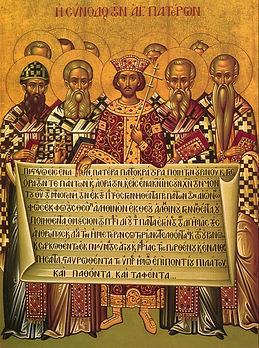
The writing of the Nicene
Creed